Reading John Spencer's post this morning, Classroom Leadership: Rewards are like Crack I thought about about our Grade 5 year long reading assignment. There is a great deal of debate around the tracks just now about the value of homework, and my school will be embarking on a study next year. I'm on the committee. And it may be that this assignment will end. This year this assignment moved from being homework to being "read-anytime."
I inherited this assignment and it has always bothered me that the task sounds daunting to begin with and that's not a great way to start the year. But we try to make it as simple and interesting as possible:
Read 20 Just-Right books in a given variety of genres over the course of the school year. Keep a record. Have a discussion with a parent after you finish the book. (Parents are given suggested questions to help with this.)
Each year there have been a few groans, "I HATE historical fiction!" "Non-fiction is so boring!" "I have to read a book in Bahasa Indonesia?" "Do we have to read fantasy? I don't like fantasy!"
We give no awards, certificates, medals. Students get none of those things. They do get discussion with a parent and with the teacher though weekly letters. They also get the satisfaction in discovering new genres that they love. And WE get the feedback in the end of year reflections that helps us decide whether or not to run it next year ....
Samples:
"I was surprised that I like historical fiction"
"I warmed to biographies after reading Kathy Freemans. I wanted to read more so Mum let me buy Andre Agassis."
"The effect of this task made historical fiction my 2nd favorite genre. If I never had this task, I would never have tried it."
"I never knew I liked biography and animal fiction."
"A genre I surprisingly liked was poetry."
"I think this was a good assignment for me because I didn't read different kinds of genres. But I found a kind of genre that I never knew it's fun. I thought it would be boring but I love it. "
"I didn't know I'd like biography so I read it second last."
I think we will keep it going!
Thursday, 7 June 2012


Wednesday, 6 June 2012
Tell Me a Story of Long Ago
As far as possible in grade 5, we try to integrate reading and writing with our units of inquiry. The "Legacies" unit is no different. During the unit students were reading non-fiction printed and digital text. We used a LiveBinder of sites for browsing and bins of books brought up from the library. Students started to identify times and events that especially interested them.
 As well as non-fiction for the project research, we were reading historical fiction. Students started with boxes of historical fiction books in groups. They looked for historical clues in the illustrations on the cover. We did historical fiction interactive read-alouds. Students identified common features of historical fiction.
Students chose books to read and picked out details that indicated the historical period.
They identified what was fiction in the book and which details were historical facts.
When there had been lots of reading of fiction and non-fiction history books, students decided what to write for their own historical fiction. We had a huge range of interests, from the Titanic, to Ancient Rome, Ancient Korea, World War 2, Ancient Egypt. Some were adventure stories. Some were journal entries. This last piece of writing for the year provided the opportunity for students to show all their 6 Traits knowledge, all their planning, note-taking and writing skills. They used NoodleTools to cite their sources.
And they did an amazing job! These are a few of their thoughts:
ONE example..... from the initial idea ...
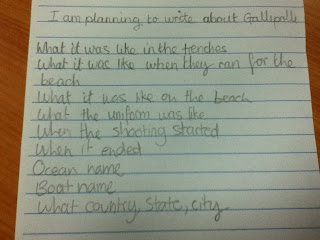
...to the final story.
I went into the garage, and a soldier in a very offical looking uniform looked up from the paper he was writing on. He said gruffly “Your name, sonny?” I replied “Caleb Taylor” and he wrote it down. He obviously knew what I was here for. I said that I wanted to be in the army, and he said “I know, mate, I’ve already got you on the list. Go and get your uniform, and report to the commanding officer.” He pointed to a doorway, and just beyond it, I could see many a rack of uniforms. Even though I would probably die in the war, I could feel myself getting excited. I was a patriot, serving my country because I believed I could help my country. I stood there, a little dazed, until the man said “Stop daydreaming, mate, and get on with it!”His voice jarred me back to reality. I walked towards the door.
There were a few soldiers in the room getting changed. I introduced myself, and they said that their names were Speed, Boxer and Point Blank. I knew that they weren’t actual names, and I asked why they had names like that. Speed said it was because he was fast in sprints, Boxer because he won a championship in 1913, and Point Blank because he was a very, very good shot. I nodded, and got changed.
I went home, in my uniform, and packed my belongings. My parents smiled at me. I could see the pain and loss of my older brother behind their eyes, and I almost said that I wouldn’t go, just for them. I promised them that I would come back.
I was sent on a boat. I was shoved on with my personals so quickly that I didn’t see the name. Most soldiers went straight to the bottom of the ship. I stayed on deck, waving to my parents. I knew they were sad, but they were proud, too. That was the expression that they showed now. They were proud. I waved my white hankie. My parents waved back. I saw the tears spring into their eyes. I felt like crying myself. But I knew I couldn’t. I would look weak in front of the commanding officer. I put my bundle of belongings, pathetically small, under my bed. They were in a canvas bag. A photo of my parents and my older brother, who had died in a gang shootout in the middle of a street. His body was riddled with bullet holes when we saw him. Caught in crossfire. I looked up. It was already dusk. I knew we had a long journey ahead, and I nodded off, dreaming of my brother, screaming and war.
I woke up with a bump, and rolled off my bed. I got up, and looked around. The boat was swaying, and most of the other men were up and about. I jumped up and went to the top deck. We were obviously in a gale. The sky was black and grey, the sea was tossing the boat as if it was a toy rubber duck in the bath. I got soaked by the rain the moment I came out. I ducked back into the barracks. We stopped in Shields, England, for a refill. Then we left.
I was sent into a rowboat, and even from this far out, I could hear the screams and shouts of men on the beaches. I rowed as fast as I could. I got off the boat. I waded as fast as I could through the water, and dived to the ground as a bullet whizzed over my head. I watched my mate, James Ormond, run past me with two other soldiers. They got mown down. It happened so quickly, my eyes almost didn’t follow. But it happened. Blood exploded from one of men heads, and the shrapnel hit the other man. James stared, and I dived at his legs. Too late. The bullet hit his left shoulder and passed through his heart. He screamed in frustration. Three dead. Three dead already! Already! I knew that I would be next. I yelled as a force hit me in the arm. I was alive, but I was tackled almost immediately by another soldier. He saved my life. I was pushed under a some sand, but my mouth and nose were sticking out of the sand, so I could breathe. I fainted.
I sat in one of the tents in Hell Spit. I had jumped aside, but my arm had flung up, and the bullet had made a flesh wound in my wrist. I had been rescued by Jack Simpson, on his donkey, Duffy. Amazingly, the Turkish soldiers had missed every single shot. It was like he had a force field around him. I would be going back to war tomorrow. A doctor came in holding a cup of water and pills, and told me to rest. I took the pills gratefully, and fell asleep.
I was sent along a trail with Jack Simpson. I got into a trench, and, amazingly, my best friend, Jock Thomas, and his mates Jackson Piper and Jack Sinn sitting in the trench. Occasionally, Jackson would jump up and fire at the opposing Turks. Once, the Turks had a lucky shot and hit one of our men as he jumped up. Seeing as I was the closest, blood sprayed all over my face. I propped the heavy body against the wall and took off my hat. The other men and my friends did the same. I had seen four men die, and I had been in the war only two days. I knew that there would be other casualties too.
I heard a clatter of a machine gun, and a scream, then a BOOM! And the machine gun fire stopped. Our nests had been wiped out yesterday by bombs, so I guessed that one of our men had thrown a grenade, but the man in the nest had noticed him before he could make it out. But he had succeeded, and blew up the nest.
Footsteps came towards us, and all twenty men aimed their guns at the entrance. A man jumped in. I raised my gun to smack him, but I realised that Turkish soldiers weren’t so stupid that they jumped into trenches full of Australian and New Zealand soldiers. The man was holding was holding a huge box, and he opened it without speaking. There was lamingtons, sandwiches, apples and bananas. The sight of lamingtons made me feel homesick. As soon as it opened, he climbed out of the trench and started to run. I heard a shot, and a thump. I peeked out. The poor guy was lying on the ground, blood pouring out from under his arm. He had obviously been shot in the heart, and he was dead as a doorknob. I asked about dragging him back into the trench so he could get a proper burial. The men in the trench agreed, because there was no machine gun nest, but there were Turks. I took the risk, and stuck my arm out to pull the body in. He landed with a thump in the trench. I propped him against the other dead man. I ate lunch, and with a full stomach, I fell asleep.
My friends told me that Thomas Irwin and Harry Morrison had been shot. Corey Irwin had been shot in the leg. They were all friends of mine. Also, Jack Simpson had been sniped on the way up Dead Man’s Ridge. Word had passed up the line fast. I groaned loudly. Jack had rescued my life twice. Now he had been shot. Other than my mates, he was the person I wanted to make it home the most. He had died in Shrapnel Valley, on the 19th of May, 1914.
I made it home. Tom Moriarty and William Kelly had both died, and they were friends of mine. Many thousands of people had died in the Battle of Gallipoli. Both sides grieved. Caleb had broken his arms and legs when jumping into the ocean off a small cliff to escape a platoon of Turkish soldiers. He was in Melbourne, slowly nursing back to health.
I was awarded the ANZAC Commemorative Medallion in 1967, when I was seventy four years old. I was proud to be at the ANZAC dawn service ever since, wearing that very medal.
I got married to Chloe Ormond, the brother of James Ormond, who I had watched die in 1914. I was proud to marry, and my friend, Jack Sinn was my best man on the wedding day,. I was 26. it was 1919.Chloe Ormond became Chloe Taylor, and I lived happily with my wife and four kids, Anthony, Pauline, Claire and Charlie.
THE END
Bibliography Greenwood, Mark. The Donkey of Gallipoli. N.p.: n.p., 2008. N. pag. Print.
Anzac Badge: image by FreakyNami http://www.flickr.com/photos/82146027
Other photos are my own.
 As well as non-fiction for the project research, we were reading historical fiction. Students started with boxes of historical fiction books in groups. They looked for historical clues in the illustrations on the cover. We did historical fiction interactive read-alouds. Students identified common features of historical fiction.
Students chose books to read and picked out details that indicated the historical period.
They identified what was fiction in the book and which details were historical facts.
When there had been lots of reading of fiction and non-fiction history books, students decided what to write for their own historical fiction. We had a huge range of interests, from the Titanic, to Ancient Rome, Ancient Korea, World War 2, Ancient Egypt. Some were adventure stories. Some were journal entries. This last piece of writing for the year provided the opportunity for students to show all their 6 Traits knowledge, all their planning, note-taking and writing skills. They used NoodleTools to cite their sources.
And they did an amazing job! These are a few of their thoughts:
- I enjoyed revising because then I could explore with different ideas.
- I enjoyed trying to make it have voice and historical facts.
- I enjoyed researching because the more I researched the more I can imagine myself as the character and give lots of detail to help my reader visualise images in their head.
- I liked developing the characters. The stage of when they change emotionally and physically. Like when a character dies, they all have sorrowness.
- I liked writing all the action and the battle scenes. It was fun describing the characters feeling when they are in battles. I liked to have a lot of detail in the one-to-one combats.
ONE example..... from the initial idea ...

...to the final story.
THE BATTLE OF GALLIPOLI

Today
was a day I would never forget. Today I was joining the army, in other
words, certain death. Many, many people died in war. I had seen the
faces of the soldiers who came home. They had come back, but they
weren’t happy. They had survived, but they weren’t celebrating.
Sometimes even when their side had won, they came back, their faces not
triumphant, but glum. I wondered if I would change too.....
I went into the garage, and a soldier in a very offical looking uniform looked up from the paper he was writing on. He said gruffly “Your name, sonny?” I replied “Caleb Taylor” and he wrote it down. He obviously knew what I was here for. I said that I wanted to be in the army, and he said “I know, mate, I’ve already got you on the list. Go and get your uniform, and report to the commanding officer.” He pointed to a doorway, and just beyond it, I could see many a rack of uniforms. Even though I would probably die in the war, I could feel myself getting excited. I was a patriot, serving my country because I believed I could help my country. I stood there, a little dazed, until the man said “Stop daydreaming, mate, and get on with it!”His voice jarred me back to reality. I walked towards the door.
There were a few soldiers in the room getting changed. I introduced myself, and they said that their names were Speed, Boxer and Point Blank. I knew that they weren’t actual names, and I asked why they had names like that. Speed said it was because he was fast in sprints, Boxer because he won a championship in 1913, and Point Blank because he was a very, very good shot. I nodded, and got changed.
I went home, in my uniform, and packed my belongings. My parents smiled at me. I could see the pain and loss of my older brother behind their eyes, and I almost said that I wouldn’t go, just for them. I promised them that I would come back.
I was sent on a boat. I was shoved on with my personals so quickly that I didn’t see the name. Most soldiers went straight to the bottom of the ship. I stayed on deck, waving to my parents. I knew they were sad, but they were proud, too. That was the expression that they showed now. They were proud. I waved my white hankie. My parents waved back. I saw the tears spring into their eyes. I felt like crying myself. But I knew I couldn’t. I would look weak in front of the commanding officer. I put my bundle of belongings, pathetically small, under my bed. They were in a canvas bag. A photo of my parents and my older brother, who had died in a gang shootout in the middle of a street. His body was riddled with bullet holes when we saw him. Caught in crossfire. I looked up. It was already dusk. I knew we had a long journey ahead, and I nodded off, dreaming of my brother, screaming and war.
I woke up with a bump, and rolled off my bed. I got up, and looked around. The boat was swaying, and most of the other men were up and about. I jumped up and went to the top deck. We were obviously in a gale. The sky was black and grey, the sea was tossing the boat as if it was a toy rubber duck in the bath. I got soaked by the rain the moment I came out. I ducked back into the barracks. We stopped in Shields, England, for a refill. Then we left.
I was sent into a rowboat, and even from this far out, I could hear the screams and shouts of men on the beaches. I rowed as fast as I could. I got off the boat. I waded as fast as I could through the water, and dived to the ground as a bullet whizzed over my head. I watched my mate, James Ormond, run past me with two other soldiers. They got mown down. It happened so quickly, my eyes almost didn’t follow. But it happened. Blood exploded from one of men heads, and the shrapnel hit the other man. James stared, and I dived at his legs. Too late. The bullet hit his left shoulder and passed through his heart. He screamed in frustration. Three dead. Three dead already! Already! I knew that I would be next. I yelled as a force hit me in the arm. I was alive, but I was tackled almost immediately by another soldier. He saved my life. I was pushed under a some sand, but my mouth and nose were sticking out of the sand, so I could breathe. I fainted.
I sat in one of the tents in Hell Spit. I had jumped aside, but my arm had flung up, and the bullet had made a flesh wound in my wrist. I had been rescued by Jack Simpson, on his donkey, Duffy. Amazingly, the Turkish soldiers had missed every single shot. It was like he had a force field around him. I would be going back to war tomorrow. A doctor came in holding a cup of water and pills, and told me to rest. I took the pills gratefully, and fell asleep.
I was sent along a trail with Jack Simpson. I got into a trench, and, amazingly, my best friend, Jock Thomas, and his mates Jackson Piper and Jack Sinn sitting in the trench. Occasionally, Jackson would jump up and fire at the opposing Turks. Once, the Turks had a lucky shot and hit one of our men as he jumped up. Seeing as I was the closest, blood sprayed all over my face. I propped the heavy body against the wall and took off my hat. The other men and my friends did the same. I had seen four men die, and I had been in the war only two days. I knew that there would be other casualties too.
I heard a clatter of a machine gun, and a scream, then a BOOM! And the machine gun fire stopped. Our nests had been wiped out yesterday by bombs, so I guessed that one of our men had thrown a grenade, but the man in the nest had noticed him before he could make it out. But he had succeeded, and blew up the nest.
Footsteps came towards us, and all twenty men aimed their guns at the entrance. A man jumped in. I raised my gun to smack him, but I realised that Turkish soldiers weren’t so stupid that they jumped into trenches full of Australian and New Zealand soldiers. The man was holding was holding a huge box, and he opened it without speaking. There was lamingtons, sandwiches, apples and bananas. The sight of lamingtons made me feel homesick. As soon as it opened, he climbed out of the trench and started to run. I heard a shot, and a thump. I peeked out. The poor guy was lying on the ground, blood pouring out from under his arm. He had obviously been shot in the heart, and he was dead as a doorknob. I asked about dragging him back into the trench so he could get a proper burial. The men in the trench agreed, because there was no machine gun nest, but there were Turks. I took the risk, and stuck my arm out to pull the body in. He landed with a thump in the trench. I propped him against the other dead man. I ate lunch, and with a full stomach, I fell asleep.
My friends told me that Thomas Irwin and Harry Morrison had been shot. Corey Irwin had been shot in the leg. They were all friends of mine. Also, Jack Simpson had been sniped on the way up Dead Man’s Ridge. Word had passed up the line fast. I groaned loudly. Jack had rescued my life twice. Now he had been shot. Other than my mates, he was the person I wanted to make it home the most. He had died in Shrapnel Valley, on the 19th of May, 1914.
I made it home. Tom Moriarty and William Kelly had both died, and they were friends of mine. Many thousands of people had died in the Battle of Gallipoli. Both sides grieved. Caleb had broken his arms and legs when jumping into the ocean off a small cliff to escape a platoon of Turkish soldiers. He was in Melbourne, slowly nursing back to health.
I was awarded the ANZAC Commemorative Medallion in 1967, when I was seventy four years old. I was proud to be at the ANZAC dawn service ever since, wearing that very medal.
I got married to Chloe Ormond, the brother of James Ormond, who I had watched die in 1914. I was proud to marry, and my friend, Jack Sinn was my best man on the wedding day,. I was 26. it was 1919.Chloe Ormond became Chloe Taylor, and I lived happily with my wife and four kids, Anthony, Pauline, Claire and Charlie.
THE END
Bibliography Greenwood, Mark. The Donkey of Gallipoli. N.p.: n.p., 2008. N. pag. Print.
Anzac Badge: image by FreakyNami http://www.flickr.com/photos/82146027
Other photos are my own.
Monday, 4 June 2012
Continuing the Wondering

Today we had our Grade 5 Legacies Expo 2012 in the theatre with lots of classes coming to see and hear and ask questions. Students showed individual and group inquiries, making use of multimedia.
This is the completion of the last of the inquiry projects of this school year.

Except, completion is the wrong word....
I do not want my students to feel that they have completed their learning in this unit.


I want them to continue to think about the legacies from past peoples and cultures from all over the world.


I want them to continue to wonder about the origins of the everyday things around them as well as the special things.


I want them to continue to be interested in historical artifacts, ideas, stories, religions, philosophies, the arts.
 |
| Making bronze |
Some students discovered a fascination for history that surprised them.
I hope that they will continue to hold this fascination all their days.
Photos are all mine.
Photos are all mine.
Sunday, 3 June 2012
Be a Risk-Taker! Do Student-Led Conferences!

For the first time, ALL the teachers at our elementary campus have facilitated Student Led Conferences.
This was a very new experience for many, but all approached it with that risk-taking attitude that we expect to see in our students. And how did they reflect?
| I used to think.... | But now I think... |
| That there would be more parents asking for a conference with the teacher | Parents are starting to understand the value of letting their child shine through their learning. |
| That younger students would not be able to communicate their learning in this kind of model | I was impressed that when given the opportunity the kids were able to share and easily talked 20-40 minutes |
| That students might find it challenging to celebrate their learning in specials without a structured model. | Students will always amaze us with their creativity, ingenuity and initiative when sharing their learning |
| it will just be the students talking and demonstrating during specials | amazed to see how hands-on some of the parents were getting. |
| That it would be great if we all did student led conferences here | we will do it again next year this way |
| That bringing all the parents in for jungle gym would be 'crazy'.... | ....our students can 'manage' their parents....in the jungle.... wihout a problem |
| More parents would ask for a separate conference time .... just a moment to talk with the teacher | None of them asked, and they were way more focused on their kid's presentations. |
| the kids would present the same as in class | family dynamics, personality, and nerves play a definite role! |
| I would have to help the kids at some point | nope, I hardly spoke at all |
| portfolios and reflective thinking had to be PERFECT | this is all part of the process of learning how to think about your learning and be reflective, all kids are in different places |
| I couldn't be in the room because parents would defer to me | I can - I just need to look really busy. |
| that even after preparing well, fourth graders would need my support to present their portfolios successfully to their parents | They were ready to do this independently. It was delightful! |
| Students would do an awesome job without me as long as we had prepped well beforehand and as always they did. | Now I wonder what else students could do in my classroom with a bit less interference from me |
| Parents wanted to hear more information about their child from the teacher | Students sharing their learning with parents is more meaningful |
| That I couldn't restrain myself from jumping in to save a child in a student led conference | now I know they CAN do it on their own and BRILLIANTLY |
| Parents would not appreciate that they don't get to hear from the teacher about their child's progress | Parents were very satisfied after hearing their child discuss his/her learning that they did not find the need to ask any further questions from the teacher. |
Friday, 1 June 2012
Using Twitter - 1 Minute PD
A few years ago our school issued teachers with copies of the book Understanding by Design. As one of the UbD trainers, I tried to think how I could get people to be reading it. You know what it's like. People are busy. There aren't enough PD days to do everything.
So I started sending out a short "quote of the day" with the page number so those interested could go directly there and read a bit more if they liked.
e.g. From Understanding By Design, page 98
"Empathy is warm; perspective is cool."
I called this "1 Minute PD" since it only took a minute (or less) to read the email!
That worked Ok. A few teachers were following the quote to the book. But what I wasn't expecting was that I'd get replies to the quote by email or personally, or I'd go to the faculty room and I'd hear it being discussed. This "1 Minute PD" was generating discussion about many aspects of UbD. And it was happening on a daily basis.
Then..... I rediscovered Twitter!
What a wealth of educational wisdom to share in 1 Minute PD!
Today I send a daily "1 Minute PD" to the faculty at my campus and the focus is Inquiry, or tech integration or better still, Literacy integration when I can find it. I add links to great blog posts that I have read that I feel will fit what we are trying to accomplish. Now we have all this wonderful information, expertise and ideas to think and talk about.
Recent examples:

24 May
5 ways to think about Creativity
http://www.melissaedwards.org/
28 May
How do we teaching critical thinking in a connected world?
http://plpnetwork.com/2012/05/
31 May
Embedding technology in the classroom - great advice!
http://www.fractuslearning.
Of course if my colleagues were all on Twitter they could do all this for themselves! #taskfornextyear
So I started sending out a short "quote of the day" with the page number so those interested could go directly there and read a bit more if they liked.
e.g. From Understanding By Design, page 98
"Empathy is warm; perspective is cool."
I called this "1 Minute PD" since it only took a minute (or less) to read the email!
That worked Ok. A few teachers were following the quote to the book. But what I wasn't expecting was that I'd get replies to the quote by email or personally, or I'd go to the faculty room and I'd hear it being discussed. This "1 Minute PD" was generating discussion about many aspects of UbD. And it was happening on a daily basis.
Then..... I rediscovered Twitter!
What a wealth of educational wisdom to share in 1 Minute PD!
Today I send a daily "1 Minute PD" to the faculty at my campus and the focus is Inquiry, or tech integration or better still, Literacy integration when I can find it. I add links to great blog posts that I have read that I feel will fit what we are trying to accomplish. Now we have all this wonderful information, expertise and ideas to think and talk about.
Recent examples:
24 May
5 ways to think about Creativity
http://www.melissaedwards.org/
28 May
How do we teaching critical thinking in a connected world?
http://plpnetwork.com/2012/05/
31 May
Embedding technology in the classroom - great advice!
http://www.fractuslearning.
Of course if my colleagues were all on Twitter they could do all this for themselves! #taskfornextyear
Saturday, 28 April 2012
Inquiry and Challenge Based Learning
The Present
In Christophe Henry's blog Life in the Middle today is a video of a group of four students in the Agri-JIS Club talking about their project. (A Challenge Based Learning Trial) As I write, they are in Geneva with two teachers at a conference co-sponsored by CERN and Apple.
Clearly they are engaged by the challenge they have set themselves. They are showing all the Essential Qualities of JIS Learners: Creative Individuals, Collaborative Workers, Effective Communicators, Self-Directed Positive Learners, Adaptable Learners, Problem Solvers and Responsible World Citizens.
These students show our newly adopted School Values of Perseverance, Balance, Compassion, Integrity, Respect and Responsibility. They share their passion for what they want to achieve.
The future?
These students worked on the project after school in a club. How would we need to change the way our schools work to be able to allow all our students to challenge themselves in this way as part of their normal school day?
OR... do we really NEED to give students this opportunity?
Maybe it's OK that this kind of learning be saved for After School Activity or occasional special days, like Earth Day, so that it doesn't interfere with our established routines....
How can we in elementary schools give our children more opportunities to engage in this type of Inquiry and Action as well as having them learn to be good readers and writers and mathematicians, etc?
The more we can do to be prepared for the future before it becomes the past, the better........ IMHO.....
In Christophe Henry's blog Life in the Middle today is a video of a group of four students in the Agri-JIS Club talking about their project. (A Challenge Based Learning Trial) As I write, they are in Geneva with two teachers at a conference co-sponsored by CERN and Apple.
Clearly they are engaged by the challenge they have set themselves. They are showing all the Essential Qualities of JIS Learners: Creative Individuals, Collaborative Workers, Effective Communicators, Self-Directed Positive Learners, Adaptable Learners, Problem Solvers and Responsible World Citizens.
These students show our newly adopted School Values of Perseverance, Balance, Compassion, Integrity, Respect and Responsibility. They share their passion for what they want to achieve.
The future?
These students worked on the project after school in a club. How would we need to change the way our schools work to be able to allow all our students to challenge themselves in this way as part of their normal school day?
OR... do we really NEED to give students this opportunity?
Maybe it's OK that this kind of learning be saved for After School Activity or occasional special days, like Earth Day, so that it doesn't interfere with our established routines....
How can we in elementary schools give our children more opportunities to engage in this type of Inquiry and Action as well as having them learn to be good readers and writers and mathematicians, etc?
The more we can do to be prepared for the future before it becomes the past, the better........ IMHO.....
Tuesday, 24 April 2012
Student-Led Conferences and Parents
With Student-Led Conferences coming up this is what I send to parents in advance. When parents are fully aware of how the conference will work they and the children will get so much more from the experience.
Dear Parents,
In Student-Led Conferences students lead their parents through different aspects of their learning. Your child will talk about his or her learning identifying areas of growth as a JIS Learner. For all the statements they make about their learning, they will show evidence which could be in many different formats and may be from multiple subject areas. (Before the conference the students will have practice in sharing and explaining their learning through role play.)
Why Student-Led Conferences?
SLCs allow students to discuss their work with their parents in the language that best suits the family – even if this is not the teacher’s language.
SLCs help parents to understand how their child sees his or her learning.
SLCs give the child the opportunity to show how he or she has accepted responsibility for learning.
SLCs promote reflection and engagement with learning.
SLCs show development of Learning Competencies.*
So, for this to work, your child must be present for this conference!
There will be a short time where you can talk just with me or you can of course schedule another appointment after the SLC.
Best regards,..........etc
* Learning Competencies:
Dear Parents,
In Student-Led Conferences students lead their parents through different aspects of their learning. Your child will talk about his or her learning identifying areas of growth as a JIS Learner. For all the statements they make about their learning, they will show evidence which could be in many different formats and may be from multiple subject areas. (Before the conference the students will have practice in sharing and explaining their learning through role play.)
Why Student-Led Conferences?
SLCs allow students to discuss their work with their parents in the language that best suits the family – even if this is not the teacher’s language.
SLCs help parents to understand how their child sees his or her learning.
SLCs give the child the opportunity to show how he or she has accepted responsibility for learning.
SLCs promote reflection and engagement with learning.
SLCs show development of Learning Competencies.*
So, for this to work, your child must be present for this conference!
There will be a short time where you can talk just with me or you can of course schedule another appointment after the SLC.
Best regards,..........etc
* Learning Competencies:
- Being resourceful
- Relating to Others
- Managing Self
- Contributing
Friday, 20 April 2012
Climate Change Animal Stories
Integrating reading, writing and inquiry processes
To conclude our grade 5 Unit of Inquiry, "Climate Control" students were given this performance task:
"Earth Day is approaching. Use this occasion to give endangered animals a voice. Use your best research skills (Big 6) to find information you can use in your story. Speak with the voice of the animal. Tell the humans about your life, what's happening with Global Warming and how it is affecting you. Tell them what they can do to try to slow down the climate change. Members of your school community will hear your voices on Earth Day, so make your message strong!"
This task ignited great excitement. All students exhibited passion for the project.
A LiveBinder was shared. It contains a few general climate change sites as well as a link to World Wildlife Fund Belgium's animal videos. This added to prior knowledge already acquired during the course of the inquiry unit.
Students drafted using google docs and shared with a classmate for peer editing.
Completed stories were printed and students used a highlighter to show the parts of their stories which used new knowledge which had come from research. They also used a coloured pencil to underline words, phrases sentences and punctuation which they felt clearly showed Voice (6 Traits Writing) in the story.
Learning new skills
We had the idea to read the stories and record them. Students recorded themselves and uploaded the audio file to our school multimedia site and from there embedded it in the blog. New and exciting for all students! On Earth Day the Grade 1 Buddies were invited to listen to the stories.


Here are a couple of examples which I had to lift from their blogs which are only shared with our class:
From Max's Blog:
Endangered Leather-Back Turtles
Max's story
Hi!! I am the Leather Back Turtle a.k.a Dermochelys Coriacea, our kinds scientific name. I am the biggest of all the other marine turtles weighing surprisingly more than a ton and as long as 6 feet (2 meters). As you can see my shell is special because it has a rubbery touch. Soft isn’t it?Other sea turtles have hardbacks, almost like stone. I use my rock-liked beak to eat my main food. I live in the cool waters in the Pacific Ocean. I love to swim because it is very refreshing to me. Most of my species lives at west coast of Mexico but some of them are just scattered around the globe.
 |
| Credits: Universal Image Group |

After two to three months in a tight space, I’m born with some of my siblings and then my parents leave me to waddle to the blue waters and live on our on. I have experience that being a turtle hatchling is very dangerous. Once, I almost got eaten alive by my natural predators: seagulls and other seabirds. Those nasty birds. I was fine and made it too the ocean but i wish i could say that for some of my other siblings.
As I swim through the ocean’s currents, I can smell a delicious odor. I traced the odor, I saw... A JELLYFISH!!! We leather backs like to eat those bobbing delicious jellyfishes. Maybe you’re wondering why my meal doesn’t sting me? Well, my rock-like beak prevents the stings from going to my rough skin. I swam towards my delicious meal but that wasn’t a jellyfish. Ohhh barnacles, it was just a floating plastic bag. Those rubbish mimic our meals every time!! If we eat those plastic bags, that will be the end of us.
There’s also another problem that’s really critical to us, it is Global Warming. Ohh, that terrible word. It is causing our kind to lose population of our species. Why do humans even need to make more and more pollution? Couldn’t they use renewable energy like solar power or wind power? Humans pollute so much by burning fossil fuel in their factories or cutting down trees instead of planting more. And everyday at least one third of all pollutants are sucked by the ocean and to the ocean plants but do you know how do they treat the ocean? By throwing trash and polluting it with oil that effects other swimming creatures! Humans don’t appreciate the ocean and what it does for them.
Do you know how global warming affects us?? Well, you’ll see that the gender of the egg depends on the surrounding air’s temperature. Now this is where global warming comes in. I found out that the temperature of the surrounding air in this nest is too hot, which means most of them will be females. If this keeps up, all the leather backs will be females!! That’s not going to help the population of our species. Soon, there won’t be a lot for us in the future.
I bet you're thinking: Why save leather back turtles in the first place? Did you know we are the ambassadors of the ocean? At least that’s what scientists say. We also “monitor” the ocean for dead corals and creatures. It’s a really sad scene to see but we have to do it. After all, we are the ambassadors. There’s also one way we help humans, a delicious way; we help humans keep the population of the jellyfishes mild... not wild. It helps the humans by decreasing the number of stings from those delicious creature. It would be ashamed to lose us, leather backs, because we are the only “soft shelled” turtles around. Sometimes I don’t understand why humans want to harm such specials animals like us.
I really would appreciate anyone who tries to help save the leather back turtles. I know some of a lot of ways that you can help us:
- You can turn off your electricity when you aren’t using it.
- Use non-polluting vehicles like bicycles or skateboards.
- You can recycle all your plastic bags and that will save a lot of turtles from dying of eating plastics.
Remember, even the most tiniest help, could make a big difference. ACT NOW.
Bibliography:
- http://nationalzoo.si.edu/SCBI/AquaticEcosystems/SeaTurtles/
- http://kids.nationalgeographic.com/kids/animals/creaturefeature/leatherback-sea-turtle/
- http://www.youtube.com/watch?v=R9rDzqPnBg8&feature=relmfuhttp://
Hanna's story
Hello there, let me introduce myself. I am a Galapagos penguin.
I live on Western Islands such as Fernandia and Isabella. I also can be located on Santiago, Bartolome, Northern Santa Cruz, Florenia, and of course the Galapagos Islands.
You might be thinking that I look like my cousins the emperor penguins in Antarctica, but I don’t at all. I have a black head and black upper parts. I also have a thin white line running from the corner of my eye to the tip of my throat. My underparts are white with a black band running across my chest. The upper part of my bill and the tip of the lower part of my bill are black. Around my eye there is a bare patch and near that a tad of my bill is pink and yellow. The females are usually smaller than males and the young ones don’t have the black chest band that adults have.
Hm, I’m feeling rather hungry. I’m a carnivore that supports on land and sea to eat. In the sea I prefer krill, small crustaceans , squid and a few species of fish. On land I eat crabs. Yum, just thinking about those delicacies make me famished. Out of everything I eat I’d have to say krill is the best. I of course have predators ,my predators consist of leopard seals,killer whales and sharks, snakes, and owls. Talking about food is killing me I’ll be right back . . .
Ah, I have just completed a delicious lunch of krill and squid that my colony helped me get. I think it is now time to rest. I usually rest in caves, cracks, and depressions of the lava flow of the Galapagos Islands. On other islands like Santiago I just live in normal cracks and caves.
Mating. Been there and done that. We Galapagos penguins tend to have one pair bond per life. A bond is reinforced by preening and bill tapping. Voila, you have a spouse for life. Two eggs are produced at an interval for roughly four days. Incubation lasts a maximum of forty days and is shared by both males and females.
There are some things on the earth that are harming my kind. One of those things is global warming. You might be wondering what global warming is. Well, global warming is when too much carbon dioxide is released into the atmosphere. This is all done by this species called ‘Humans’. These ‘Humans’ are burning fossil fuels, like coal for energy to run things like airplanes, cars, and trains. But as ‘humans’ burn fossil fuels to use them it releases carbon dioxide.
How is this effecting my kind you might ask? Well, now scientists are studying islands which I inhabit to see if global warming has an impact on a Galapagos penguins like myself. Right now on Galapagos Island scientists are not letting fisheries near the island or oil companies. So far the scientists on Galapagos Island suspect the water temperature has risen. If the temperature goes up by only one degree a huge chunk of my diet could be cut off because the sea animals aren’t used to the temperature. I’m already endangered by the oil companies and the fisheries. I beg you with all my heart that you can prevent me from facing the horrible effects of climate change.
The next time you use an electronic like a laptop or television. Think of my kind and how much we could suffer and try to prevent it from disrupting our lifestyle and the delicate food chain. If you are deciding on what kinds of cars to buy, buy something that doesn’t use fossil fuels to run, for instance a hybrid. Also, try to carpool a lot, it saves energy. Another thing you could do is to use solar power energy to power the electronics wind turbines could also work.
If you try these tips you could save me. So, consider these tips and we could make a huge step to prevent me from being extinct. Remember, there is no age limit to save the earth. Thank you, I hope the next time you hear from me my kind will be thriving.
Bibliography
arkive images of life on earth. N.p., n.d. Web. 13 Mar. 2012. <http://www.arkive.org/galapagos-penguin/spheniscus-mendiculus/
#text=Threats>.
a-z-animals. N.p., n.d. Web. 15 Mar. 2012. <http://a-z-animals.com/animals/ galapagos-penguin/>.
unep-wcmc-apps. N.p., n.d. Web. 15 Mar. 2012. <http://www.unep-wcmc-apps.org/sdb/Taxonomy/tax-species-result.cfm?SpeciesNo=20610>.
wwf. N.p., n.d. Web. 16 Mar. 2012. <http://wwf.panda.org/>.
Hm, I’m feeling rather hungry. I’m a carnivore that supports on land and sea to eat. In the sea I prefer krill, small crustaceans , squid and a few species of fish. On land I eat crabs. Yum, just thinking about those delicacies make me famished. Out of everything I eat I’d have to say krill is the best. I of course have predators ,my predators consist of leopard seals,killer whales and sharks, snakes, and owls. Talking about food is killing me I’ll be right back . . .
Ah, I have just completed a delicious lunch of krill and squid that my colony helped me get. I think it is now time to rest. I usually rest in caves, cracks, and depressions of the lava flow of the Galapagos Islands. On other islands like Santiago I just live in normal cracks and caves.
Mating. Been there and done that. We Galapagos penguins tend to have one pair bond per life. A bond is reinforced by preening and bill tapping. Voila, you have a spouse for life. Two eggs are produced at an interval for roughly four days. Incubation lasts a maximum of forty days and is shared by both males and females.
There are some things on the earth that are harming my kind. One of those things is global warming. You might be wondering what global warming is. Well, global warming is when too much carbon dioxide is released into the atmosphere. This is all done by this species called ‘Humans’. These ‘Humans’ are burning fossil fuels, like coal for energy to run things like airplanes, cars, and trains. But as ‘humans’ burn fossil fuels to use them it releases carbon dioxide.
How is this effecting my kind you might ask? Well, now scientists are studying islands which I inhabit to see if global warming has an impact on a Galapagos penguins like myself. Right now on Galapagos Island scientists are not letting fisheries near the island or oil companies. So far the scientists on Galapagos Island suspect the water temperature has risen. If the temperature goes up by only one degree a huge chunk of my diet could be cut off because the sea animals aren’t used to the temperature. I’m already endangered by the oil companies and the fisheries. I beg you with all my heart that you can prevent me from facing the horrible effects of climate change.
The next time you use an electronic like a laptop or television. Think of my kind and how much we could suffer and try to prevent it from disrupting our lifestyle and the delicate food chain. If you are deciding on what kinds of cars to buy, buy something that doesn’t use fossil fuels to run, for instance a hybrid. Also, try to carpool a lot, it saves energy. Another thing you could do is to use solar power energy to power the electronics wind turbines could also work.
If you try these tips you could save me. So, consider these tips and we could make a huge step to prevent me from being extinct. Remember, there is no age limit to save the earth. Thank you, I hope the next time you hear from me my kind will be thriving.
Bibliography
arkive images of life on earth. N.p., n.d. Web. 13 Mar. 2012. <http://www.arkive.org/galapagos-penguin/spheniscus-mendiculus/
#text=Threats>.
a-z-animals. N.p., n.d. Web. 15 Mar. 2012. <http://a-z-animals.com/animals/ galapagos-penguin/>.
unep-wcmc-apps. N.p., n.d. Web. 15 Mar. 2012. <http://www.unep-wcmc-apps.org/sdb/Taxonomy/tax-species-result.cfm?SpeciesNo=20610>.
wwf. N.p., n.d. Web. 16 Mar. 2012. <http://wwf.panda.org/>.

Any comments left here for Hanna or Max will be passed on to them.
Grade 5 Reflecting on Learning
A large part of our most useful assessment in Grade 5 is in the form of student reflection.
Students are encouraged to think and write about some of these things:
From "Kyrene's Grade 5 Blog"
Any comments posted which are for Charlotte or Kyrene will be pasted on their blogs by me.
Students are encouraged to think and write about some of these things:
- what they've been learning (knowledge and skills)
- how they are learning
- why they are learning
- what they feel they have done well
- what was challenging
- what they might improve on
- how learning has changed their viewpoints
- how learning will change their actions
- what they are still wondering about
- how they see themselves as JIS Learners
- how they show the JIS Values
Often these reflections are written as blog posts. Have a look. These are reflections following the unit Climate Control which ended with publishing the animal stories. These were lifted off the students' blogs which are only shared within our class.
From "Charlotte's 5th Grade Blog"
From "Charlotte's 5th Grade Blog"
Climate Control Reflection
We've been learning about climate control. I've learned a lot from this unit. I learned about how the green house effect works. Also how burning fossil fuels can pollute the earth and how it gets made. I also learned about renewable energy and how it makes energy and doesn't pollute the earth like burning fossil fuels.When we were working on our animal stories I also learned some new information. I learned about the polar bears life style and what it likes to eat. What we need to do to help and why global warming is effecting their home.
I've also learned some new skills, especially when doing our the animal story. A new skill that I learned was pasting a recording into your blog or in dragon tales. Also how to be careful picking pictures on the Internet because you might not be able to use them. We also learned how to do an audio. I've also learned how to write a story but being another person or species. I also learned how to comment on a persons blog, but saying good comments. Also I learned how to use a microscope which was really interesting.
But there is one part that I enjoyed the most about this unit in Climate Control. I enjoyed doing the presentation on renewable energy because I learned a lot of new information and how it really helps the earth.
Learning about this unit not only had given me new information but it has changed me as a person. When we were talking about fossil fuels it made me turn off my lights and AC more often because I want our earth to be clean and better place for us and animals to live in. Also when we were writing our animal stories it made me think if I were that polar bear living in the Arctic but now with frozen ice, but with melting ice and not enough food for me to eat. As I remembered that, I've been changing how I live so that I could try to make a change.
I think that this unit really helped me learn more about how to be more active in helping to stop global warming. I also thought that this unit was really fun because we got to do a lot of group activities which made me stronger in working together with other people.
In the future I will try to recycle more and not throw away my empty cans and bottles. I will try to not use the water so much. I will try to turn off the AC and lights as much as possible. I'll try not to use the the car to much and maybe ride a bike or walk.
This unit was a fun unit to work on, I hope to do those things that I said that I would try to do.
I've also learned some new skills, especially when doing our the animal story. A new skill that I learned was pasting a recording into your blog or in dragon tales. Also how to be careful picking pictures on the Internet because you might not be able to use them. We also learned how to do an audio. I've also learned how to write a story but being another person or species. I also learned how to comment on a persons blog, but saying good comments. Also I learned how to use a microscope which was really interesting.
But there is one part that I enjoyed the most about this unit in Climate Control. I enjoyed doing the presentation on renewable energy because I learned a lot of new information and how it really helps the earth.
Learning about this unit not only had given me new information but it has changed me as a person. When we were talking about fossil fuels it made me turn off my lights and AC more often because I want our earth to be clean and better place for us and animals to live in. Also when we were writing our animal stories it made me think if I were that polar bear living in the Arctic but now with frozen ice, but with melting ice and not enough food for me to eat. As I remembered that, I've been changing how I live so that I could try to make a change.
I think that this unit really helped me learn more about how to be more active in helping to stop global warming. I also thought that this unit was really fun because we got to do a lot of group activities which made me stronger in working together with other people.
In the future I will try to recycle more and not throw away my empty cans and bottles. I will try to not use the water so much. I will try to turn off the AC and lights as much as possible. I'll try not to use the the car to much and maybe ride a bike or walk.
This unit was a fun unit to work on, I hope to do those things that I said that I would try to do.
The climate change unit
We are finishing of the climate change unit and these are some of my
thoughts about the unit. Also what I learned and some things that I will
do to stop climate change.
I learned lots of things that I hadn't known before. First I didn't know what the greenhouse effect was and then after the climate change unit I found that it was when some greenhouse gases trap sunlight in the earth making it warmer instead of reflecting the sunlight back into space it is trapped on earth making the climate warmer. I also learnt about renewable energy.
I also learnt that because of climate change many animals will start dying out because when the earth heats up and the ice melts then there won't be much ice left for the animals who live in cold weather and because of the heat they may be not cold enough and then they will start dying out and then the food chain will be ruined. I also learnt about some animals that were affected by climate change the animal that I mainly learnt about was the arctic fox and how its affected by climate change.
I also learnt some skills in the climate change unit. I learnt how to use sound recorder and make a podcast of me reading aloud my story about an animal that was affected by climate change. I also learnt how to insert something into Dragontales, a website where we can share videos, pictures and audio files. I also learnt how to insert an audio file into blogger. I also learnt how to use the microscope.
The best thing that I learned was that if we can help by stop using electronics and wasting water and wasting paper we can stop climate change and help animals who are effected by climate change.
Since we have started this unit it has changed me in many different ways I have come to realise that because of us humans maybe there won't be a next generation of people and there might not be any more animals in the world.
I thought that this unit was very useful because it taught me things that I hadn't know before and that it has made me realise if I don't stop cotributing to global warming there might not be any more animals, humans or trees left in the world.
After learning about climate change I have decided to stop wasting water and paper and to stop using private transportation and more public transport and that I have stopped using too much electricty. I also have started to recycle more.
This unit has taught me alot and I hope to find out more about climate change and how I can help.
I learned lots of things that I hadn't known before. First I didn't know what the greenhouse effect was and then after the climate change unit I found that it was when some greenhouse gases trap sunlight in the earth making it warmer instead of reflecting the sunlight back into space it is trapped on earth making the climate warmer. I also learnt about renewable energy.
I also learnt that because of climate change many animals will start dying out because when the earth heats up and the ice melts then there won't be much ice left for the animals who live in cold weather and because of the heat they may be not cold enough and then they will start dying out and then the food chain will be ruined. I also learnt about some animals that were affected by climate change the animal that I mainly learnt about was the arctic fox and how its affected by climate change.
I also learnt some skills in the climate change unit. I learnt how to use sound recorder and make a podcast of me reading aloud my story about an animal that was affected by climate change. I also learnt how to insert something into Dragontales, a website where we can share videos, pictures and audio files. I also learnt how to insert an audio file into blogger. I also learnt how to use the microscope.
The best thing that I learned was that if we can help by stop using electronics and wasting water and wasting paper we can stop climate change and help animals who are effected by climate change.
Since we have started this unit it has changed me in many different ways I have come to realise that because of us humans maybe there won't be a next generation of people and there might not be any more animals in the world.
I thought that this unit was very useful because it taught me things that I hadn't know before and that it has made me realise if I don't stop cotributing to global warming there might not be any more animals, humans or trees left in the world.
After learning about climate change I have decided to stop wasting water and paper and to stop using private transportation and more public transport and that I have stopped using too much electricty. I also have started to recycle more.
This unit has taught me alot and I hope to find out more about climate change and how I can help.
Any comments posted which are for Charlotte or Kyrene will be pasted on their blogs by me.
Friday, 13 April 2012
Using Internet Images
For a long time it has bothered me that our students were going straight to google for images, and copying and pasting images that they did not have permission to use. But difficult to say much when I could not offer an alternative.
But this year, we were introduced to compfight at the start-of-year tech inservice by Chrissy Hellyer. Now towards the end of the year, I can happily report that my students will automatically go to compfight for pictures, but not only this! If Flickr doesn't have pictures they like, they will not go to Google but will instead try other Creative Commons or free images sites which they have discovered off their own bat! Self-Directed Positive Learners* indeed!
Here's the lesson I have been using, which is saved on our network so that students who forget steps can access it at any time.
But this year, we were introduced to compfight at the start-of-year tech inservice by Chrissy Hellyer. Now towards the end of the year, I can happily report that my students will automatically go to compfight for pictures, but not only this! If Flickr doesn't have pictures they like, they will not go to Google but will instead try other Creative Commons or free images sites which they have discovered off their own bat! Self-Directed Positive Learners* indeed!
Here's the lesson I have been using, which is saved on our network so that students who forget steps can access it at any time.
Using Compfight for Internet images
* Self-Directed Positive Learner: One of the seven Essential Qualities of JIS Learners
Tuesday, 10 April 2012
Blogging with Students
I have just finished reading and commenting on my class's blogs. They just get better and better! Very gratifying at this time of the year.
Like everything new, it takes time to learn of course and now three years of blogging later, we all have a better idea of what it's all about. I find I can also talk about the blogging as a blogger myself and this really has made a big difference this year, perhaps because I now understand the process better.
When we started three years ago, the children's blogs were very basic. There wasn't a lot of substance to posts. There were lots of exclamation marks!!!!!!!!!!!!!!!!!!!!!!!!!!!!!!!!!! And enough swimming fish, fluffy bunnies, cute ponies, virtual pets.... to open a mini-zoo!
Generally each year my students take to blogging like ducks to water, being far less self-conscious about their writing than I. Not that that meant that they were producing quality work! I struggled with improving what they were doing.
And then, at the start of this school year, we had a tech inservice with guest, Chrissy Hellyer from ISBangkok who shared her experiences. And this year I got back into twitter and there is no shortage of great ideas being shared! The most useful has been Kim Coffino whose work at ISBangkok and Yokohama IS has been (and continues to be) inspiring, and Steven Anderson who tweets so many useful ideas.
My students and I understand that it is no less important to talk about writing for the blog than for any other type of writing. They are mostly all clear about what is expected and in my blog that I share with my class, I give reminders and sometimes target particular aspects to think about.
We have agreed that:
Like everything new, it takes time to learn of course and now three years of blogging later, we all have a better idea of what it's all about. I find I can also talk about the blogging as a blogger myself and this really has made a big difference this year, perhaps because I now understand the process better.
When we started three years ago, the children's blogs were very basic. There wasn't a lot of substance to posts. There were lots of exclamation marks!!!!!!!!!!!!!!!!!!!!!!!!!!!!!!!!!! And enough swimming fish, fluffy bunnies, cute ponies, virtual pets.... to open a mini-zoo!
Generally each year my students take to blogging like ducks to water, being far less self-conscious about their writing than I. Not that that meant that they were producing quality work! I struggled with improving what they were doing.
And then, at the start of this school year, we had a tech inservice with guest, Chrissy Hellyer from ISBangkok who shared her experiences. And this year I got back into twitter and there is no shortage of great ideas being shared! The most useful has been Kim Coffino whose work at ISBangkok and Yokohama IS has been (and continues to be) inspiring, and Steven Anderson who tweets so many useful ideas.
My students and I understand that it is no less important to talk about writing for the blog than for any other type of writing. They are mostly all clear about what is expected and in my blog that I share with my class, I give reminders and sometimes target particular aspects to think about.
We have agreed that:
- We use 6 Traits so therefore that writing process should be used for blogging as it is for any other writing.
- We look at examples of good reflections and identify what makes them good and I expect them to really think deeply.
- We talk about commenting. I make sure now that there is always time to comment on each other's blog posts and expect to see this happening.
- We talk about suitable language and what expectations on a school blog would look like.
- We talk about netiquette, decide on how that should look in our interactions with each other in emails and blogs (just as we look at our behaviours in the classroom) and there is an expectation that everyone will follow.
What
should your Grade 5 Blog look like? DRAFT
Aspect
|
Criteria
|
Overall Appearance
|
●
Your blog looks tidy, simple, organized, academic.
●
You can be as creative as you like to make your blog
reflect you as a learner.
●
You can use bright colors to catch the reader’s
attention.
●
Your title and tagline are interesting so that
readers want to know more.
|
Text
|
●
The fonts are simple, easy to read, consistent size.
●
Contrasting colors for the background and text make
it easy to see and read.
●
Your topics and interactions with others are
positive.
●
The topic of your blog posts is consistent with the
theme.
●
You use 6 Traits Writing Process.
●
Your writing is appropriate for your audience.
|
Pages
|
●
You can organise your different topics/themes into
pages.
●
The page about yourself has a short description about
the author to help readers understand who is writing.
●
You follow JIS Acceptable Use Policy guidelines for
posting personal information.
|
Images
|
●
Images match the text. They have captions if needed.
●
They are evenly spaced.
●
You use images that you have permission to use.
●
Attributions are shown.
|
Links
|
●
Links within posts and on sidebar are to your
classmates’ blogs or are school related sites or sites to do with your
topics.
|
Commenting
|
●
You comment on other blogs regularly, following the
commenting guidelines.
●
You reply to other people’s comments on your post
when appropriate.
|
Subscribe to:
Posts (Atom)